
Blood Sugar, Dopamine, and the ADHD Brain: Why What Kids Eat in the Morning Matters by Afternoon
If your child with ADHD tends to fall apart somewhere between 3:00 and 4:00 in the afternoon (the meltdown the moment they walk in the door, the homework explosion, the emotional spiral that seems to come out of nowhere), there's something important you need to know.
That 3:30 meltdown was decided at breakfast.
Not by bad parenting, or a bad day, but by blood sugar biology. Once you understand how it works in the ADHD brain specifically, you will never look at your morning routine the same way again.
What happens in your child's brain after a processed breakfast
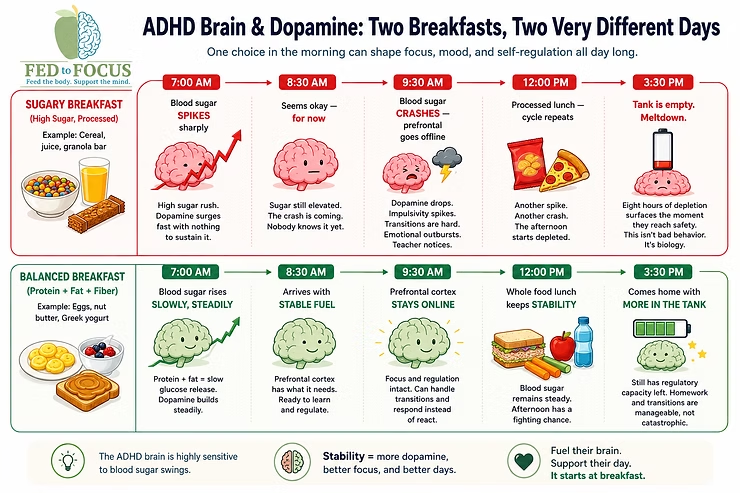
When a child starts the day with a typical processed breakfast like cereal, toast, a juice box, or a granola bar, their blood sugar spikes sharply within about 45 minutes. For a neurotypical child this is not ideal, but for an ADHD child it is significantly more damaging.
Here's why: the part of the brain most affected by a blood sugar crash is the prefrontal cortex – the area responsible for impulse control, emotional regulation, focus, and decision making. In an ADHD brain the prefrontal cortex is already the weakest link, maturing two to three years behind schedule and running on a dysregulated dopamine system. When blood sugar drops (and with a processed breakfast it will drop, usually before mid-morning), the prefrontal cortex has fewer resources and executive functioning becomes harder.
What that looks like in a classroom at 9:30am is increased impulsivity, difficulty with transitions, emotional outbursts, inability to focus. What the teacher sees as behavior is actually neurology. The child isn't choosing to act out. Their brain just lost its most important regulatory resource.
The connection to dopamine
Dopamine is the brain chemical that ADHD brains are already short on. It's responsible for motivation, focus, and the ability to self-regulate. Here's where food comes in directly: dopamine is built from amino acids, and amino acids come from protein. A breakfast with no protein gives the ADHD brain almost no raw material to produce the very neurotransmitter it's already struggling to make enough of.
At the same time, ultra-processed foods provide a fast, reliable dopamine hit that the ADHD brain is neurologically wired to seek out. The pull your child feels toward sugary, processed snacks isn't a preference or a lack of willpower, it's a depleted brain looking for the fastest available source of the chemical it needs most. Understanding that changes everything about how you approach food battles.
Why the crash keeps building all day
By the time your child has held themselves together through six or seven hours of school, using every ounce of their regulatory capacity just to get through the day, they arrive home with nothing left. If lunch was also processed, the cycle repeated itself at noon. The after-school explosion isn't poor behavior. It's a depleted nervous system that has finally reached safety and has nothing left to hold together.
The good news is that this cycle is highly reversible, and it starts with one meal.
What a brain-supporting breakfast actually looks like
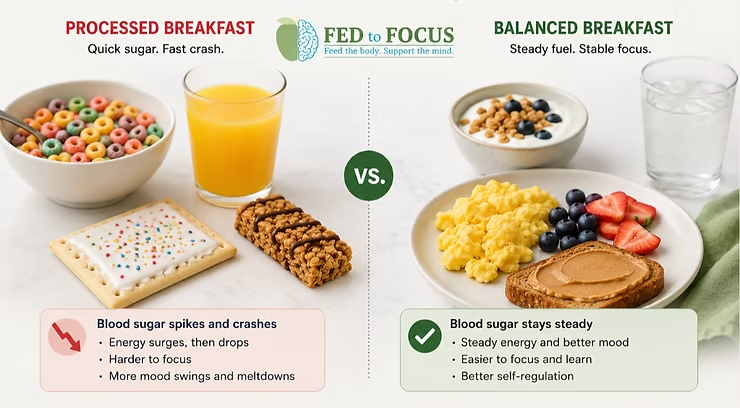
Research and clinical experience consistently point to the same three-component breakfast formula for ADHD children: protein, fat, and fiber. These three together create slow, stable energy release without the spike and crash. Protein provides the amino acids the brain needs to produce dopamine. Fat slows glucose absorption. Fiber stabilizes blood sugar further.
In real life that looks like: eggs any style, Greek yogurt with berries, nut butter on whole grain toast, a smoothie with protein and a fat source, overnight oats. Most of these take under ten minutes. The goal isn't a perfect breakfast every single day, it's replacing the spike-and-crash cycle with something that gives your child's brain a fighting chance before they even walk out the door.
One change to your child's breakfast can change the entire neurological trajectory of their school day. That is not an overstatement. That is blood sugar biology.
Next up...
Post 3: Artificial dyes, additives, and hyperactivity: the evidence parents need to know.
This is a five post series. If you missed post 1, you can click here to read it.
References:
Bloch MH, Qawasmi A. Omega-3 fatty acid supplementation for the treatment of children with attention-deficit/hyperactivity disorder symptomatology: systematic review and meta-analysis. Journal of the American Academy of Child and Adolescent Psychiatry. 2011;50(10):991–1000. doi:10.1016/j.jaac.2011.06.008
Ptacek R, Kuzelova H, Stefano GB. Dopamine dysregulation in ADHD: evidence and therapeutic implications. Neuroendocrinology Letters. 2011;32(5):551–558.
Pelsser LM, Frankena K, Toorman J, Buitelaar JK. Diet and ADHD, reviewing the evidence: a systematic review of meta-analyses of double-blind placebo-controlled trials evaluating the efficacy of diet interventions on the behavior of children with ADHD. PLOS ONE. 2017;12(1):e0169277. doi:10.1371/journal.pone.0169277
Wiles NJ, Northstone K, Emmett P, Lewis G. 'Junk food' diet and childhood behavioural problems: results from the ALSPAC cohort. European Journal of Clinical Nutrition. 2009;63(4):491–498. doi:10.1038/ejcn.2008.14

HEY, I'M MICHELLE.
I'm a former kindergarten teacher turned certified nutritionist and health educator, currently completing my Master's in Health Education and Behavior at the University of Florida.
After a decade in the classroom, I started noticing a pattern between what kids ate and how they showed up to learn, and I went back to school to understand why. I'm also a mom navigating this with my own child.
Fed to Focus is where I translate the research into something useful for your family.


JOIN MY MAILING LIST
©2026 Fed to Focus | Privacy Policy | Terms & Conditions