
The Connection Between Ultra-Processed Food and ADHD Symptoms: What the Research Says
If you're raising a child with ADHD, your days probably involve a lot of managing. Managing the mornings, the meltdowns, the homework battles, the emotional explosions and the phone calls from school. You're doing everything you've been told to do, and you're exhausted.
Here's something most doctors don't bring up at the appointment: what your child is eating every day may be making all of that significantly harder than it has to be.
That's not a guilt trip. It's actually the most hopeful thing in this post, because unlike genetics, unlike brain chemistry, and unlike the long wait for a therapy appointment, the food in your kitchen is something you can change.
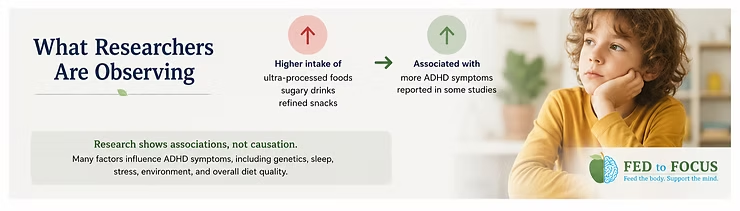
What researchers have been finding
Scientists have been studying the link between diet and ADHD for years, and the picture keeps getting clearer. A 2023 study published in the journal Nutrients looked at children with and without ADHD and found that kids who ate the most processed foods and sweets were more than twice as likely to have an ADHD diagnosis compared to kids who ate the least (Yan et al., 2023). A separate study found that children with ADHD consistently ate more processed snacks, packaged sweets, and processed meat products than their peers, and that the more of those foods they ate, the worse their ADHD symptoms tended to be (Akin et al., 2022).
One of the most talked-about recent studies came out of the University of Toronto in March 2026, published in JAMA Network Open (one of the most respected medical journals in the world). Researchers followed over 2,000 Canadian children and found that kids who ate more ultra-processed foods at age 3 showed more behavioral and emotional difficulties by age 5, including hyperactivity, aggression, anxiety, and fearfulness (Kavanagh et al., 2026). What made this study particularly striking is that the problems showed up before most kids would even receive an ADHD diagnosis. The food environment in the earliest years of life appears to matter more than most people realize.
This doesn't mean food caused your child's ADHD
ADHD is a real neurological condition. The brain of a child with ADHD is genuinely wired differently, particularly in how it produces and uses dopamine – the chemical responsible for focus, motivation, and self-regulation. No amount of dietary change is going to rewire it, and this isn't about finding something to blame.
Think of it like this: your child's ADHD brain is already carrying a heavy backpack just to get through a normal day. Processed food is like adding extra weight to that backpack. It doesn't give them ADHD, but it makes everything they're already carrying that much heavier. Switching to real food won't take the backpack away, but it can absolutely lighten the load.
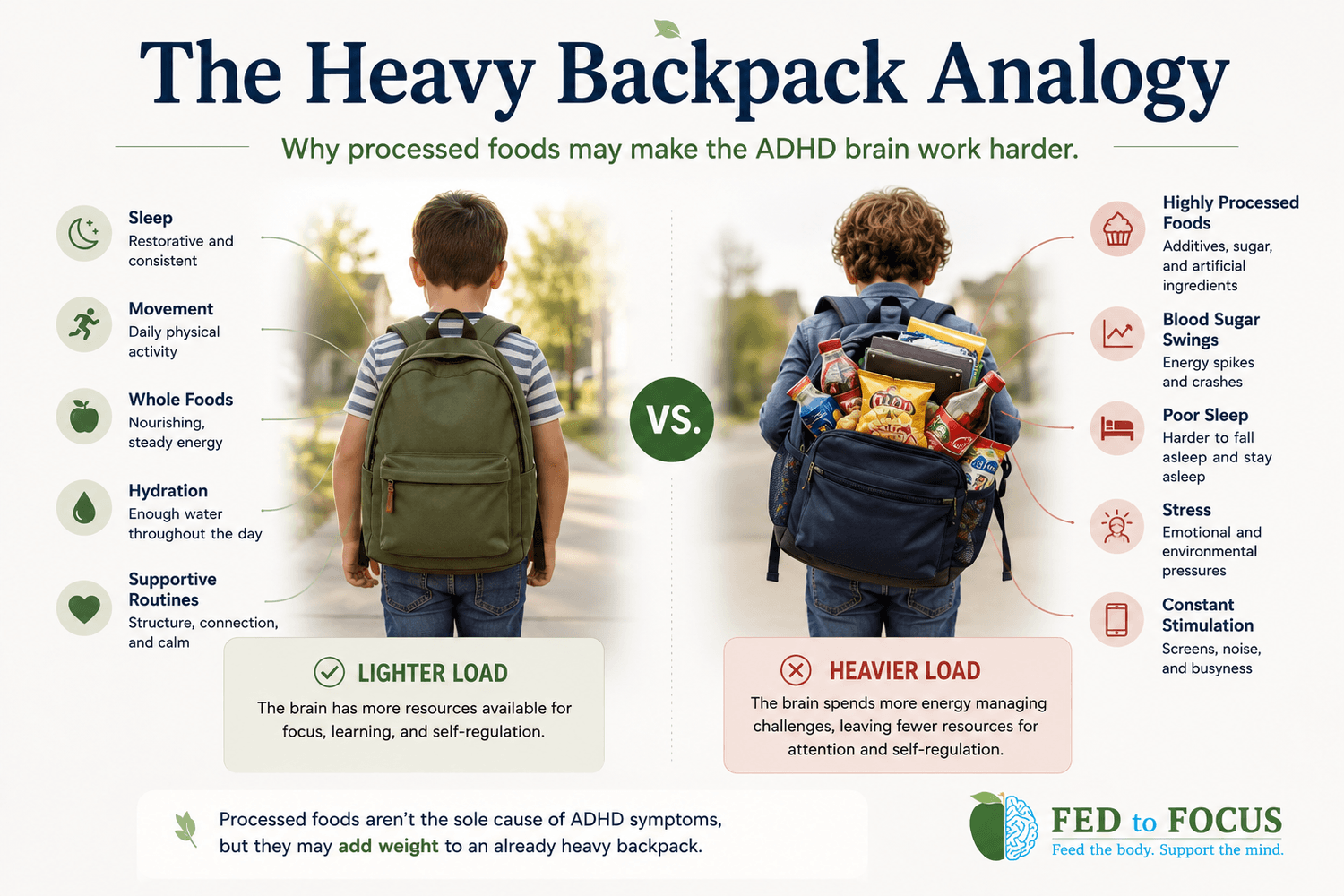
Why this matters for your family right now
Research has found that rising rates of behavioral and attention challenges in children run alongside rising ultra-processed food consumption (Chamarthi et al., 2025). That parallel isn't a coincidence, and it points to something families can actually do something about.
The next four posts in this series will walk you through exactly how this works in the brain, what the specific culprits are, what the evidence says about making dietary changes, and most importantly, how to do it in a real family with real kids who love their snacks.
References:
Akin, S. (2021). Processed Meat Products and Snacks Consumption in ADHD: A case-control study. Northern Clinics of Istanbul, 9(3). https://doi.org/10.14744/nci.2021.64497
Chamarthi VS, Shirsat P, Sonavane K, Parsi S, Ravi U, Ponnam HC, Bindlish S, Nadler EP, Kashyap R, Ro S. The impact of ultra-processed foods on pediatric health. Obes Pillars. 2025 Sep 9;16:100203. doi:10.1016/j.obpill.2025.100203
Kavanagh, M. E., Chen, Z. H., Tamana, S. K., Moraes, T. J., Simons, E., Turvey, S. E., Subbarao, P., Mandhane, P. J., & Miliku, K. (2026). Ultraprocessed Food Consumption and Behavioral Outcomes in Canadian Children. JAMA Network Open, 9(3), e260434. https://doi.org/10.1001/jamanetworkopen.2026.0434
Yan, W., Lin, S., Wu, D., Shi, Y., Dou, L., & Li, X. (2023). Processed Food-Sweets Patterns and Related Behaviors with Attention Deficit Hyperactivity Disorder among Children: A Case-Control Study. Nutrients, 15(5), 1254. https://doi.org/10.3390/nu15051254

HEY, I'M MICHELLE.
I'm a former kindergarten teacher turned certified nutritionist and health educator, currently completing my Master's in Health Education and Behavior at the University of Florida.
After a decade in the classroom, I started noticing a pattern between what kids ate and how they showed up to learn, and I went back to school to understand why. I'm also a mom navigating this with my own child.
Fed to Focus is where I translate the research into something useful for your family.


JOIN MY MAILING LIST
©2026 Fed to Focus | Privacy Policy | Terms & Conditions